Custom Event Setup

×

Click on the elements you want to track as custom events. Selected elements will appear in the list below.

Selected Elements (0)

    Lithium Solar Batteries

    WattCycle’s LiFePO4 deep cycle solar battery stands guard over your home’s power and cuts your electricity bills.

    Step-by-Step Solar System Installation Guide

    1. Calculate Your Energy Needs: Determine your daily power consumption, considering all appliances and devices you’ll use. This will help you size your battery, solar panels, and other components.
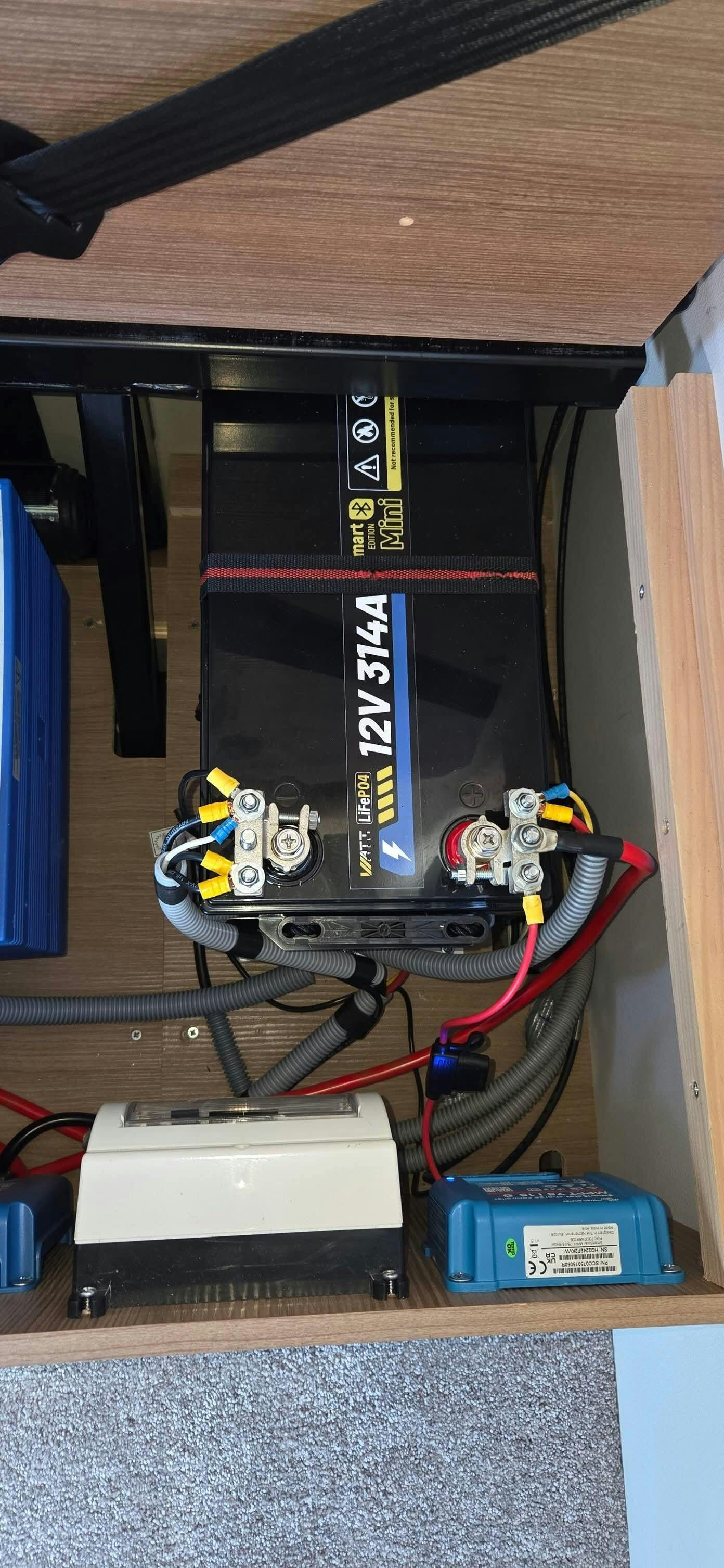
    2. Mount the Battery: Secure the battery enclosure near your inverter, ensuring adequate ventilation.
    3. Connect DC Cables: Run appropriately sized positive and negative cables from the battery’s BMS terminals to the inverter’s battery input.
    4. Link to Solar Charge Controller: If using a dedicated MPPT, wire its battery output to the same DC bus.
    5. Integrate Monitoring: Connect the BMS communication port (RS485/CAN) to your inverter or gateway for real-time data.
    6. Verify & Energize: Tighten all terminals, confirm polarity, then switch on the battery and inverter in sequence per WattCycle instructions.

    For a full guide on setting up your solar energy storage system, head over to our blog.

    Photovoltaic System Accessories

      Power Your Green Life with Confidence

      At WattCycle, we build our lithium batteries using highest quality materials for long-lasting performance. Designed to get the most out of your solar setup, they’re ready for both on-grid and off-grid use. And with zero maintenance required, you can count on steady power—no check, no fuss, just energy independence on your terms.

      • On-Grid

      A solar on-grid system, also known as a grid-tied solar system, is linked to both the solar panels and the main grid. This means you can draw power from your panels or the grid, and you can also automatically send excess solar power to the grid.

      • Off-Grid

      An off-grid solar system is a solar panel system that has no connection to the utility grid at all. This means that all of your system's power comes from the panels, so you don't need to rely on an external power source. You can meet your energy needs entirely through solar power and stored batteries.

      • Hybird

      A hybrid solar system is a system that uses the combination and integration of solar power with a backup power source (usually a generator or the main grid) and battery storage to generate electricity.

      Best Advice for Charging LiFePO4 with Solar

      Array Sizing: Aim for a PV array capacity 1.2–1.5× your lithium battery bank’s watt-hour rating to replenish daily depth of discharge.

      Charge Controller Settings: Set bulk/absorption voltage to 14.4 V (for 12 V systems) and float to 13.6 V; enable temperature compensation if available.

      Seasonal Adjustments: In low-sun months, reduce discharge depth to 40 %–50 % and consider shifting absorption time longer; in high-sun seasons, you can safely utilize up to 80 % DOD for maximum yield.

        Series-Parallel Guide

        Battery System Capacity (For Example Using WattCycle 12V 314Ah Mini Bluetooth Batteries) Appliances and Power Supported
        12V System 314Ah 628Ah (2 in parallel) 942Ah (3 in parallel) 1256Ah (4 in parallel) Small devices such as lights, fans, and low-power appliances.
        24V System 314Ah (2 in series) 628Ah (4: 2S2P) 942Ah (6: 2S3P) 1256Ah (8: 2S4P) Medium-power devices like refrigerators, TVs, and power tools.
        36V System 314Ah (3 in series) 628Ah (6: 3S2P) 942Ah (9: 3S3P) 1256Ah (12: 3S4P) High-power equipment like air conditioners, pumps, and electric tools.
        48V System 314Ah (4 in series) 628Ah (8: 4S2P) 942Ah (12: 4S3P) 1256Ah (16: 4S4P) Whole-home energy systems, multiple high-power appliances, and solar energy storage setups.

        12V System

        Capacity: 280Ah

        2 batteries in parallel: 560Ah

        3 batteries in parallel: 840Ah

        4 batteries in parallel: 1120Ah

        Appliances: Small devices such as lights, fans, and low-power appliances.

        24V System

        Capacity: 280Ah (2 batteries in series)

        4 batteries (2 series, 2 parallel): 560Ah

        6 batteries (2 series, 3 parallel): 840Ah

        8 batteries (2 series, 4 parallel): 1120Ah

        Appliances: Medium-power devices like refrigerators, TVs, and power tools.

        36V System

        Capacity: 280Ah (3 batteries in series)

        6 batteries (3 series, 2 parallel): 560Ah

        9 batteries (3 series, 3 parallel): 840Ah

        12 batteries (3 series, 4 parallel): 1120Ah

        Appliances: High-power equipment like air conditioners, pumps, and electric tools.

        48V System

        Capacity: 280Ah (4 batteries in series)

        8 batteries (4 series, 2 parallel): 560Ah

        12 batteries (4 series, 3 parallel): 840Ah

        16 batteries (4 series, 4 parallel): 1120Ah

        Appliances: Whole-home energy systems, multiple high-power appliances, and solar energy storage setups.

        Wattcycle News

          Join WattCycle VIP

          Join WattCycle VIP

          Subscribe for 5% OFF Get the latest News!