

 EU
EU US
US DE
DE UK
UK UA
UA CA
CA AU
AU NZ
NZWhat Is Active Balancing in LiFePO4 Batteries, and Why Does WattCycle Use It?
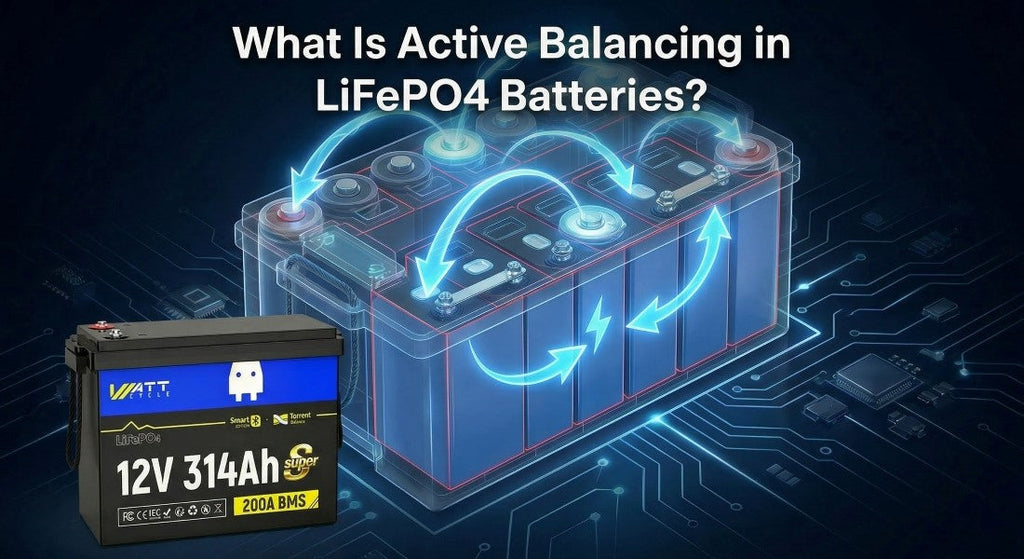
You have followed the correct charging procedure. The battery is within its rated capacity. Yet over time, something is not right: A battery that once charged quickly now seems to take longer to reach full charge, or a system that shuts down earlier than expected even though the rated capacity suggests there should still be energy remaining. These are not random anomalies, and they are not signs of a defective product.
In many cases the underlying cause is something far more common in multi-cell lithium iron phosphate systems: gradual cell voltage drift. A well-documented electrochemical phenomenon that develops gradually in any multi-cell lithium iron phosphate battery system put through repeated charge and discharge cycles. Left unmanaged, this drift quietly erodes the performance of an otherwise sound battery from the inside out.
Because in any LiFePO4 battery, multiple cells are connected in series to achieve the required system voltage. Over time and through repeated charge and discharge cycles, small differences between individual cells can cause their state of charge to diverge. This raises two important questions for users. What causes this cell drift in the first place, and how does active balancing correct it?
Table of Contents
- Why LiFePO4 Cells Drift Apart Over Time
- What Is Active Balancing?
- Active Balancing vs. Passive
- 4 Ways Active Balancing Changes How Your Battery Performs
- Why WattCycle Uses Active Balancing as Standard
- Conclusion
Why LiFePO4 Cells Drift Apart Over Time
A LiFePO4 battery is not a single energy storage unit. It is an assembly of individual cells connected in series. While each cell is manufactured to a defined specification, no two cells are perfectly identical. Minor variations in capacity, internal resistance, and self-discharge rate are inherent to the electrochemical manufacturing process, and they are present in every multi-cell pack regardless of brand or production quality.
Under normal operating conditions, these small differences are sufficient to cause State of Charge (SoC) divergence. Even if all cells begin a charge cycle at the same SoC, they will not end it at exactly the same level. Repeated across hundreds of cycles, these incremental differences accumulate into a meaningful imbalance, with individual cells progressively drifting to different SoC levels within the same pack.
The consequence is measurable and direct. The Battery Management System (BMS) must protect every cell in the battery, which means it uses the weakest cell as the reference point for both charge cutoff and discharge cutoff. The weakest cell is the one that reaches its voltage limit first. The practical result is that the entire battery's usable energy becomes constrained by its lowest-performing cell, regardless of how much capacity the remaining cells still hold.
As the imbalance widens over successive cycles, the effects compound. Usable capacity continues to decline, safe charge rates must be reduced to protect the weakest cells from over-voltage, and the accelerated stress on out-of-balance cells shortens the overall service life of the battery.
This is not a manufacturing defect, nor is it specific to any single producer. Any brand or manufacturer will encounter such a problem. It is a fundamental electrochemical reality of series-connected lithium cell systems, and it is precisely the problem that active balancing is engineered to address.
What Is Active Balancing?
Active balancing is a cell management technique in which charge is actively transferred from higher-SoC cells to lower-SoC cells during operation, rather than dissipating the voltage difference as heat. The objective is to maintain SoC uniformity across all cells within the battery, ensuring that no single cell is left significantly ahead of or behind the others at any point in the charge or discharge cycle.
At the operational level, the Battery Management System continuously monitors the voltage of each individual cell and redirects charge bidirectionally where divergence is detected. This is an ongoing process, not a one-time correction. The BMS adjusts charge distribution in real time to keep all cells operating within a narrow, consistent voltage band.
For the user, active balancing functions entirely in the background. It requires no manual configuration, no scheduled maintenance, and no intervention under normal operating conditions. The system manages cell-level balance automatically from the moment the battery is in use.
WattCycle's active balancing system operates at a continuous balancing current of 3 A. This rate is sufficient to correct meaningful SoC drift not only during rest periods, but throughout active charge and discharge cycles, which is where cell divergence develops most rapidly under real operating conditions.
Active Balancing vs. Passive Balancing
In a passive balancing system, the BMS identifies cells that have reached a higher SoC than the others and bleeds off the excess voltage through resistive elements, converting the energy difference into heat. The higher cells are brought down to match the lower ones. No energy is recovered or redistributed. It is a straightforward correction method, and it is widely used in lower-cost battery designs because the components required are simpler and less expensive.
Active balancing operates on a fundamentally different principle. Rather than discarding excess charge as heat, the BMS transfers it directly from higher-SoC cells to lower-SoC cells. The energy that would otherwise be wasted is instead used to raise the cells that are falling behind. The battery retains more of its total charge, and the correction is made without generating unnecessary heat in the process.
| Passive Balancing | Active Balancing | |
|---|---|---|
| Energy handling | Dissipated as heat | Transferred to lower-SoC cells |
| Thermal output | Higher | Lower |
| Balancing current | Typically in the mA range | WattCycle continuous 3A |
| Effect on capacity over time | Faster degradation | Slower capacity fade |
Passive balancing is a viable solution in low-demand or infrequently cycled applications, but it carries measurable long-term trade-offs. A balancing method that operates in the milliamp range and generates heat as a byproduct is less equipped to keep pace with the SoC divergence that develops under regular deep cycling. Over time, those limitations translate into reduced usable capacity, earlier charge cutoffs, and a shorter overall service life for the battery.
Active balancing does not lower the high points to achieve uniformity. It raises the low points. That distinction, sustained across thousands of charge and discharge cycles, is what separates a battery that maintains its performance over years of use from one that gradually falls short of its rated specification.
4 Ways Active Balancing Changes How Your Battery Performs
The technical principle of active balancing is straightforward. Its consequences for real-world battery performance, however, extend across multiple dimensions that directly affect how a system behaves over its service life. The following four outcomes represent what active balancing delivers in practice.
1. Higher Usable Capacity
When cells within a battery are held at closely matched SoC levels, the Battery Management System is no longer forced to terminate charge or discharge cycles based on the limits of the weakest cell. Every cell contributes its available energy to the usable output of the battery, rather than a portion of that capacity being effectively locked off by the lowest-performing cell. Users gain access to more of the battery's rated capacity on every cycle, without any change to how the system is operated.
2. Support for Higher and Fuller Charging
Cell imbalance creates overvoltage risk during charging. When individual cells are at different SoC levels, the weakest or most advanced cell may reach its upper voltage limit before the rest of the battery has fully charged, forcing the BMS to terminate the cycle early. Active balancing maintains SoC uniformity across all cells, removing the condition that triggers premature charge cutoff and allowing the battery to accept higher charge currents and reach a fuller state of charge consistently.
3. Lower Thermal Output During Operation
Passive balancing generates heat as a direct consequence of dissipating excess charge through resistive elements. Active balancing eliminates that heat source by transferring energy between cells rather than discarding it. The result is lower thermal output during the balancing process, which is a meaningful advantage in enclosed installations, thermally sensitive environments, and applications where ambient temperatures are already elevated.
4. Slower Capacity Fade Over the Service Life
Cell imbalance is one of the primary drivers of accelerated capacity degradation in series-connected lithium batteries. Cells that repeatedly operate outside their optimal SoC range experience greater electrochemical stress on every cycle, and that stress accumulates into measurable capacity loss over time. By continuously correcting SoC divergence, active balancing reduces that cycle-by-cycle stress across all cells, sustaining more stable and predictable performance over a longer service period and extending the interval before meaningful capacity fade becomes apparent.
Why WattCycle Uses Active Balancing as Standard
Cell imbalance is a manageable challenge, and many LiFePO4 batteries handle it adequately for the applications they are designed to serve. What active balancing introduces is a meaningful step forward: rather than simply managing the consequences of SoC divergence, it addresses the source directly, keeping all cells operating in closer alignment from cycle to cycle.
WattCycle incorporates active balancing at a continuous 3 A rate as a standard feature across its LiFePO4 product line because the benefits it delivers are substantive and measurable. More usable capacity on every cycle. Fuller and faster charge acceptance. Lower thermal output during operation. A slower rate of capacity fade over the service life of the battery. These are not marginal improvements. They are the compounding result of a balancing system that works continuously and actively, rather than reactively.
For users whose systems demand consistent output, reliable charge performance, and stable capacity over multiple years of regular use, active balancing represents a design advantage that becomes more apparent the longer the battery is in service. It is an investment in long-term performance, and it is built into every WattCycle LiFePO4 battery as standard in the future.
Conclusion
Active balancing represents a meaningful advancement in how LiFePO4 batteries manage one of their most fundamental challenges. Cell imbalance is not a condition that can be eliminated, but it can be controlled continuously, precisely, and without any input from the user. When it is, the results are measurable: more usable capacity, fuller and faster charging, lower operating temperatures, and a slower rate of capacity fade over the service life of the battery.
For users evaluating LiFePO4 batteries for solar storage, backup power, marine, or any application where reliable long-term performance matters, the balancing method built into the battery is worth understanding. (If you are sizing a large-scale setup, you might also need to convert MWh to kWh to accurately calculate your total energy requirements.) It is one of the more consequential design decisions in the system, and its effects compound over years of regular use.
WattCycle's integration of active balancing at a continuous 3A rate reflects a straightforward engineering priority: building a battery that performs as close to its rated specification as possible, for as long as possible, under real-world operating conditions. That is the standard every WattCycle LiFePO4 battery is built to meet.



![[Buying Guide] WattCycle Battery Black Friday Deals 2025](http://eu.wattcycle.com/cdn/shop/articles/WattCycle_Black_Friday_Battery_Sale_Blog_b6317472-80a2-4376-8d0f-1c58beaec39a_100x100_crop_center.jpg?v=1763611054)