

 EU
EU US
US DE
DE UK
UK UA
UA CA
CA AU
AU NZ
NZMWh to kWh Calculator: Convert Megawatt-hours to Kilowatt-hours Instantly

Need to convert MWh to kWh quickly? Whether you're analyzing solar energy production, comparing battery storage systems, reviewing electricity consumption, or working with energy market data, converting megawatt-hours (MWh) to kilowatt-hours (kWh) is simple.
In this guide, you'll find a free MWh to kWh calculator, conversion formulas, a handy conversion chart, and practical examples to help you understand these common energy units.
Free MWh to kWh Calculator
Use our free calculator to instantly convert megawatt-hours (MWh) to kilowatt-hours (kWh) and vice versa. Simply enter a value into either field and the result will update automatically.
MWh to kWh Real-Time Converter
Formula: 1 MWh = 1000 kWh | Simply enter any value to calculate.
How to Convert MWh to kWh or kWh to MWh?
The conversion between MWh and kWh is based on a fixed factor of 1,000. To convert MWh to kWh, multiply the MWh value by 1,000. To convert kWh back to MWh, divide the kWh value by 1,000.
- 2.5 MWh = 2,500 kWh
- 5 MWh = 5,000 kWh
- 4,500 kWh = 4.5 MWh
MWh to kWh Conversion Chart
Use the following MWh to kWh conversion chart for quick reference:
| Megawatt-hours (MWh) | Kilowatt-hours (kWh) |
|---|---|
| 0.5 MWh | 500 kWh |
| 1 MWh | 1,000 kWh |
| 2 MWh | 2,000 kWh |
| 5 MWh | 5,000 kWh |
| 10 MWh | 10,000 kWh |
| 20 MWh | 20,000 kWh |
| 50 MWh | 50,000 kWh |
| 100 MWh | 100,000 kWh |
Understanding Common Energy Units: MWh, kWh, mWh etc.
When comparing battery storage systems, solar energy production, or electricity consumption, you may encounter several different energy units.
- mWh (milliwatt-hour): A tiny unit mainly used in sensors, microelectronics, and low-power devices.
- Wh (watt-hour): Commonly used for small batteries, power banks, and portable electronics.
- kWh (kilowatt-hour): The standard unit for residential electricity usage, solar batteries, and electricity pricing.
- MWh (megawatt-hour): Used for utility-scale solar farms, commercial energy storage systems, and electricity markets.
mWh and MWh are not the same unit. The lowercase m means milli, while the uppercase M means mega. One MWh is 1,000,000,000 times larger than one mWh.
The relationship between these units is straightforward:
1 MWh = 1,000 kWh = 1,000,000 Wh = 1,000,000,000 mWh
For residential energy storage systems, capacities are typically measured in kWh. Utility-scale battery projects and large solar installations are usually measured in MWh due to their much larger energy capacity.
How MWh and kWh Are Used in Battery Storage Systems
While MWh and kWh are both units of energy, they are typically used for different types of battery storage systems.
Residential batteries and portable power stations are usually rated in kilowatt-hours (kWh), while large commercial and utility-scale energy storage projects are often measured in megawatt-hours (MWh).
| Application | Typical Capacity | Common Unit |
|---|---|---|
| Portable Power Station | 0.5–2 kWh | kWh |
| RV Battery Bank | 2–10 kWh | kWh |
| Home Solar Battery | 5–30 kWh | kWh |
| Commercial Energy Storage | 100–500 kWh | kWh or MWh |
| Container Battery Storage | 1–20 MWh | MWh |
Example: What Does a 5 kWh Battery Mean in Real Life and buy a battery Storage?
Most residential battery systems are measured in kWh rather than MWh because homeowners typically focus on daily energy consumption and backup requirements.
For example, a 5 kWh battery can store 5 kilowatt-hours of electricity, which may be enough to power essential household loads such as lighting, internet equipment, refrigerators, and small appliances for several hours, depending on energy usage.
The WattCycle NextGen 51.2V 100Ah LiFePO4 Battery provides approximately 5 kWh of usable energy storage, making it a practical option for home solar storage, off-grid cabins, RVs, and backup power applications.

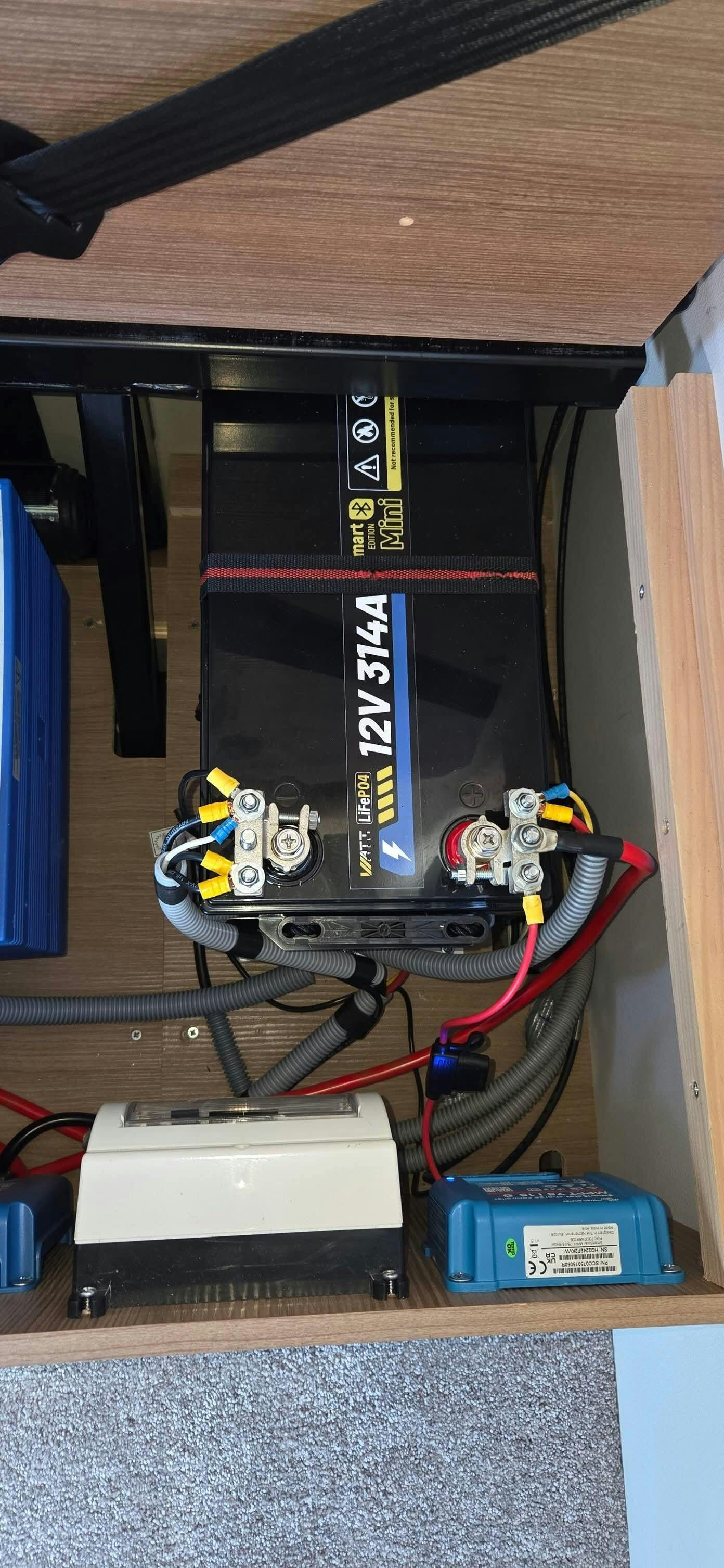
Battery capacity is even more important in mobile and off-grid setups. For example, when designing a motorhome power system, understanding the relationship between daily energy consumption and battery capacity helps determine how much storage is required for appliances, lighting, and charging devices.
If you're planning an RV or motorhome electrical system, our guide on how to design a power system for a motorhome explains how to estimate energy usage and choose the right battery capacity.
Frequently Asked Questions About MWh and kWh
How many kWh are in 1 MWh?
One megawatt-hour (MWh) equals exactly 1,000 kilowatt-hours (kWh).
Is 10 kWh per day a lot?
For a typical two- to three-person household, 10 kWh per day is considered a normal electricity consumption level. This equals approximately 3,650 kWh, or 3.65 MWh, per year.
When planning a solar energy storage system, understanding your daily electricity usage is essential. A household consuming around 10 kWh per day may benefit from a battery storage system in the 5–15 kWh range, depending on solar production and consumption patterns.
For example, the WattCycle NextGen 5 kWh LiFePO4 Solar Battery can help homeowners store excess solar energy and reduce reliance on grid electricity during peak usage hours.
How many MWh does a typical house use per year?
Household electricity consumption is measured in kilowatt-hours (kWh) or megawatt-hours (MWh), which measure energy over time.
Most single-family homes consume between 3,000 and 6,000 kWh of electricity per year. This is equivalent to approximately 3 to 6 MWh annually.
For example:
- 3,000 kWh = 3 MWh
- 4,500 kWh = 4.5 MWh
- 6,000 kWh = 6 MWh
Homes with electric vehicles, heat pumps, or larger families may consume significantly more electricity, often reaching 8–12 MWh per year or higher.
Understanding the difference between kWh, MWh, and MW is especially useful when evaluating solar systems, battery storage capacity, or electricity consumption reports.
What is the difference between MW and MWh?
MW (megawatt) measures power, while MWh (megawatt-hour) measures energy. For example, a 1 MW solar plant operating at full output for one hour produces 1 MWh of energy.
Conclusion
Converting MWh to kWh is straightforward once you know the conversion factor: 1 MWh = 1,000 kWh. Whether you're evaluating solar energy production, comparing battery storage systems, reviewing electricity consumption, or analyzing energy market data, understanding the relationship between MWh and kWh makes energy information much easier to interpret.
With the calculator, conversion chart, and examples above, you can convert MWh to kWh accurately in just a few seconds.